
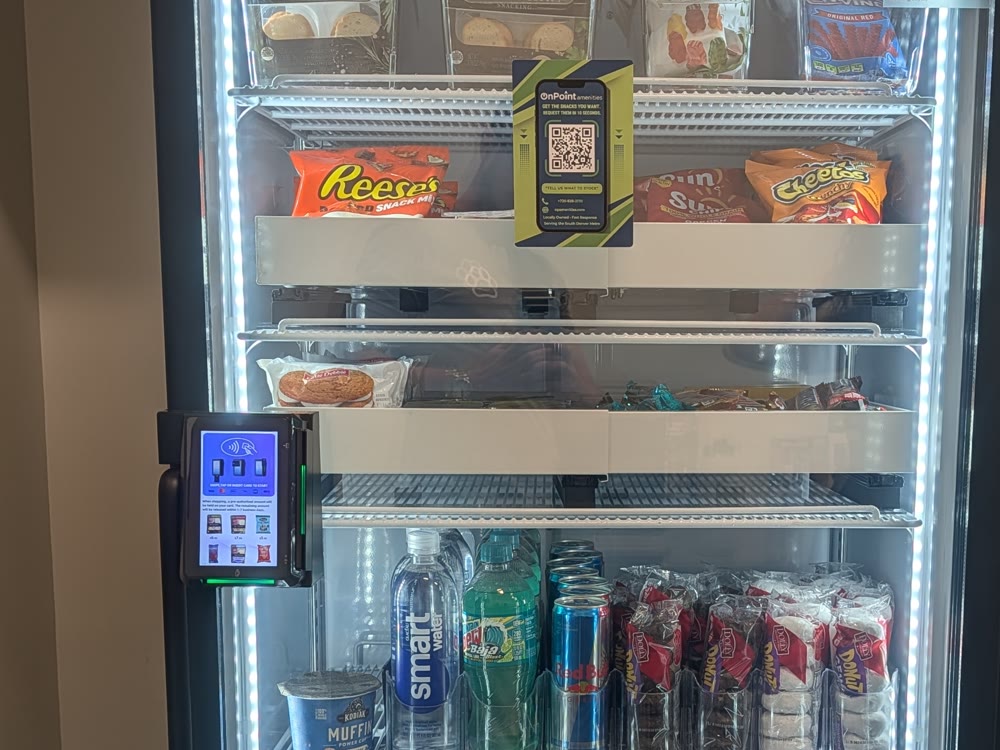
 our install
Almost every property manager we walk in Highlands Ranch, Lone Tree, Parker, or the Denver Tech Center asks some version of the same question: should this space get a vending machine or a micro market? Most vending companies answer that question by selling whatever they have more of that month. We answer it by looking at your property.
There isn't a universally "better" option. There's the right fit for your building's traffic, your available square footage, and how your residents, employees, or members actually move through the day. Here's how we actually make that call — the same way we'd walk it with you on-site.
The Real Question Isn't "Better" — It's Traffic and Space
A vending machine is a single, compact footprint that works anywhere you can plug it in. A micro market needs enough steady foot traffic to justify an open, self-checkout setup with more shelving, more variety, and a bigger footprint. Neither is an upgrade over the other — they're built for different volumes.
The question we ask on a site walk isn't "which do you want," it's "how many people pass through this space, how often, and what does the room actually allow." That answer looks different in a 40-person office suite in Centennial than it does in a 300-unit apartment clubhouse in Parker.
When a Vending Machine (or Smart Cooler) Is the Right Call
Smaller headcounts and tighter spaces do better with a compact, single-unit solution. We see this most often in:
- Office suites under roughly 50 people in the Denver Tech Center, Centennial, and Littleton corridor, where a breakroom has floor space but not open square footage
- Auto dealership service bays and waiting rooms in Aurora and Lakewood, where customers want something fast between drop-off and pickup, not a browsing experience
- Single-shift warehouses and light-industrial spaces where the crowd is real but concentrated into short windows
Most of what we install in these spots isn't a coin-and-spiral machine — it's a cashless smart cooler: one upright unit, unlocked with a card or phone, that holds drinks, snacks, and fresh grab-and-go food in a footprint about the size of a standard fridge. It's the vending-machine format without the jams, and it can hold more variety than people expect from something that compact.
When a Micro Market Makes More Sense
Once a property has the traffic to support it, an open micro market setup earns its footprint back many times over. That's typically:
- Apartment communities with an active clubhouse or leasing-office common area in Highlands Ranch, Lone Tree, or Parker, where residents linger and want real variety, not just a quick grab
- Larger corporate offices and HQ-style buildings in the Tech Center or downtown Denver, where headcount easily clears the traffic a micro market needs
- Gyms with a steady member base throughout the day, where protein, hydration, and recovery snacks get bought again and again by the same regulars
- Healthcare facilities running round-the-clock shifts, where staff and visitors need more selection at 2 a.m. than a single machine can carry
A micro market also works better where the property wants the space itself to feel like an amenity — open shelving reads as a perk in a way a machine bolted to the wall doesn't.
What Doesn't Change, Whichever You Pick
The format changes; the terms don't. Every install — smart cooler or micro market — comes with the same no-cost model: equipment, installation, and ongoing maintenance are free to the property, because On Point Amenities earns from what sells, not from a bill sent to you. Every unit is cashless, monitored remotely, and serviced locally, usually next-day. And the product mix gets built around what the specific building's people actually buy, not a generic template.
If a property genuinely sits in between — too much traffic for one machine, not quite enough for a full open market — that's exactly the gap a cashless smart cooler is built to fill. It's the option we reach for most often across the South Denver Metro precisely because most buildings here land in that middle range.
How We Decide for Your Property
We don't quote a format over the phone. A free on-site walk lets us check power access, floor plan, and realistic foot traffic, then recommend whichever setup actually fits — not whichever one we'd rather install. From a signed agreement, plan on about 4–8 weeks to a stocked, running installation.
If you're weighing this decision for a property anywhere in the South Denver Metro, we're glad to walk it with you and give you a straight answer either way.

Veteran, Castle Rock local, and the person who stocks the machines these posts are written from. Every install on this site is one he services personally.
Not ready to talk? Audit your own space first.
The 5-Minute Amenity Audit — twelve checkboxes to run on your current setup. No email required. If most of them pass, you don’t need us.
Not sure which fits your property? Let's walk it.
A free on-site assessment takes twenty minutes — and ends with a straight answer, not a sales pitch.
Book a Free Assessment